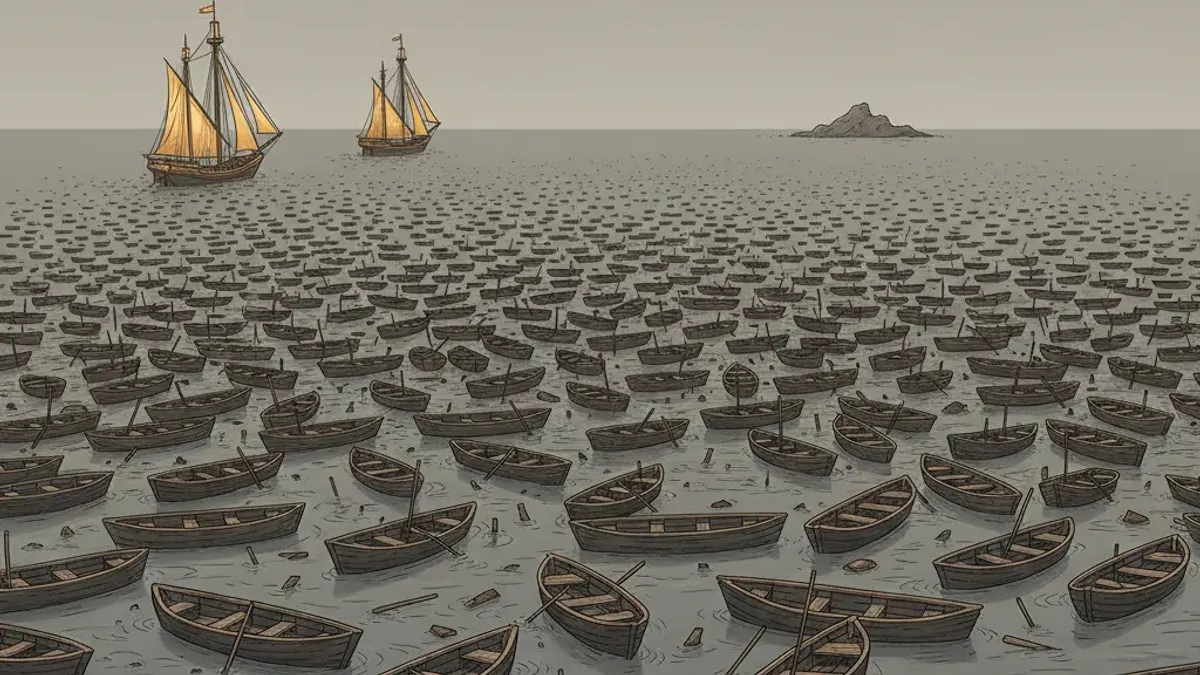
15,000 AI Products Are Fighting for Your Users — Here's Why 90% Will Die and What to Do Instead
The SaaSpocalypse wiped $285B from software stocks. Building costs collapsed from $100M to $30. After two failed products, I found the survival playbook for indie developers.
I shipped two products in 10 days. Zero paying users.
The first was a curated software directory — technically sound, feature-complete, even got some HN discussion. The second was a demand validation tool that scored 8.6 out of 10 in our own scoring system — the highest of all candidates.
Both died. Not because they were bad. Because while I was building them, hundreds of people were building roughly the same thing. And most of them will die too.
Then I saw the SaaSpocalypse data and realized: my failure wasn’t an anomaly. It was a symptom of a structural shift.
February 3, 2026: $285 Billion Vanishes
Software stocks crashed. The S&P 500 Software & Services Index dropped over 4% in a single day, then kept falling for 8 consecutive sessions — down ~20% for the year.
The market was pricing in a verdict: traditional SaaS business models might not survive.
Forrester published a blog literally titled “SaaS As We Know It Is Dead”. The Databricks CEO said AI will make SaaS “irrelevant”. These aren’t startups crying wolf — these are industry leaders acknowledging the rules have changed.
Two structural forces are colliding simultaneously.
First, AI agents are replacing SaaS itself. Klarna replaced the work of 700 customer service agents with AI, cutting resolution time from 11 minutes to 2. When an AI agent can handle your support tickets, generate reports, and manage projects directly, do you still need to log into a dashboard? Per-seat pricing assumes humans use software. When agents use it instead, the model breaks.
Second, building costs have collapsed to a degree that’s hard to believe.
From $100M to $30
The cost to train a GPT-4-class model: $100M in 2023, $5M with DeepSeek in 2024, $30 with TinyZero in 2025.
The application layer followed. Two engineers with Cursor now ship what used to take ten. Non-technical founders are launching paid products in 2-4 weeks.
The result? Supply explosion.
There are now 15,000-25,000 AI wrapper products in the market, with 70-105 new ones launching every week — that’s 12 new competitors entering every single day. By end of 2026, expect 35,000-50,000.
Market Clarity rates the AI wrapper market 9.5/10 on competition intensity.
Of these products, 60-70% generate zero revenue. Only 3-5% make over $10K/month. 90% of AI startups will fail in their first year — 20 percentage points higher than the traditional startup failure rate of 70%.
When building costs approach zero, anything you build can be copied next week. Features are no longer a moat. “Build a better product” is no longer a survival strategy.
Good Products Die Too
The SaaSpocalypse narrative is usually “bad AI wrappers get filtered out, good products survive.” Sounds reasonable. But the data tells a harsher story.
Market Clarity’s research shows AI wrapper users retain for only 4-8 months, with 40-60% churning in the first 2-3 months. Free-to-paid conversion sits at 2-5%. This isn’t a product quality problem — it’s rational user behavior when facing infinite choice. When 35,000 products compete for the same users’ attention, the rational move is: try, get dissatisfied, switch to the next one.
A Google VP explicitly warned that two types of AI startups won’t survive: “thin wrappers around foundation models” and “products dependent on a single model API.” Notice — he didn’t say “bad products.” He said “products without structural moats.”
Product quality is the entry ticket, not the moat. In a supply explosion, what survives isn’t the best product — it’s the hardest to replace.
What Survives: Three Characteristics
From VC investment data, Market Clarity’s research, and real survival cases, products that make it through share three traits:
Proprietary data. Everyone can call the same AI models, but your decade of customer industry data, supply chain records, compliance logs — nobody else has those. Veeva Systems built its moat on 20 years of life sciences clinical trial and compliance data — even Salesforce couldn’t replicate those data assets. Data compounds over time and can’t be copied. It’s the only moat that grows stronger with age.
Vertical workflows. Generic tools get replaced fastest. But products embedded in specific industry workflows have massive switching costs. Toast started with restaurant POS and deeply integrated ordering, inventory, staff scheduling, and tax compliance into one system — switching away from Toast means rebuilding your entire restaurant operation. Vertical SaaS hit $94.86B in 2026 with funding growing 7% YoY — bucking the overall AI investment contraction.
Trust relationships. The most underrated moat. When all products converge on similar features, user decisions shift from “which works better” to “who do I trust.” Cursor turned down OpenAI’s acquisition offer and reached a $9B valuation — not through unique features, but through deep developer community trust and 360K+ paying user stickiness.
The inverse is equally clear. What doesn’t survive: pure GPT/Claude wrappers, point solutions with no path to system-of-record, pure feature differentiation (AI progress will erase it), single-model API dependency.
The Indie Developer’s Path Forward
If you’re an indie developer reading this, you might feel despair. 15,000 competitors, 90% death rate, zero building costs — how do you play this game?
But the data hides good news too.
Superframeworks’ analysis argues the SaaSpocalypse is devastating for large companies but actually an opportunity for indie developers. Big companies carry heavy burdens — teams, offices, investor expectations. When per-seat revenue drops, they buckle. Indie developers don’t have that overhead; their cost structure is naturally leaner.
The key is choosing the right path.
The path most people take:
Build product → Cold launch → Pray for discoveryThis path is essentially dead in a supply explosion. I walked it twice. Both times I failed — not from poor execution, but from having zero followers, zero trust, and zero distribution. Among 15,000 products, you simply won’t be seen.
A better path:
Offer services → Build trust → Productize deliveryAmy Hoy took this exact path. She started with time management consulting, discovered her clients kept hitting the same pain point — time tracking was miserable — and productized her consulting insights into Noko (formerly Freckle), a time tracking SaaS that’s been profitable for over a decade. Services aren’t a detour — they’re the fastest way to build trust and accumulate proprietary data.
The service-first logic:
- Revenue from Day 1 (no waiting for product completion)
- Accumulate proprietary data through service delivery (clients’ real problems, industry knowledge)
- Trust makes you price-insensitive (no race to the bottom)
- Gradual productization (manual → semi-automated → fully automated)
This aligns with what I found in my distribution strategy analysis: relationship distribution > algorithm distribution. In a supply explosion, trust is distribution, and distribution is survival.
After two failures, I abandoned the “build product → cold launch” path myself and pivoted to a brand-first strategy: build trust through original research and opinionated content first, then monetize through services and products. In my product form analysis, I wrote about how AI-era product forms are diverging — from traditional SaaS to Chat-native Skills to Personal AI Pipelines. But regardless of form, the prerequisite is the same: someone has to be willing to listen to you.
The SaaSpocalypse isn’t an ending. It’s a filter — removing products without moats, leaving those with trust, data, and vertical depth.
For indie developers, the core question was never “can I build it?” In the AI era, anyone can build anything.
The question is: why you?
FAQ
If building costs are zero, what’s an indie developer’s actual advantage?
Not technical ability — AI has leveled that playing field. Your real advantage is low cost structure + domain depth. Big companies run 20-person teams per product line; a 30% drop in per-seat revenue triggers layoffs. Indie developers don’t carry that overhead. But you must have insights or data in a specific vertical that nobody else has, or you’re just another one of 15,000 wrappers. The litmus test: can your product be replicated by a weekend project? If yes, don’t build it.
Does the service-first path work for everyone? What are the limitations?
Not for everyone. Service-first requires enough domain expertise that people will pay for your time. If you’re a pure technologist with no industry experience, you may need to build domain credibility first through content (deep analyses, public research) before transitioning to services. The other limitation is scalability — service revenue is time-bound. You must intentionally productize repetitive parts of your service delivery, or you’ll end up in a “premium freelancing” trap.
Will AI agents actually replace SaaS? What’s the timeline?
Not full replacement — delivery model transformation. Simple CRUD operations (pulling data, generating reports, batch processing) will be absorbed by agents first — Klarna has already proven this. But complex workflows involving compliance, multi-party collaboration, and domain-specific logic won’t disappear; they’ll shift from “humans operating interfaces” to “agents calling APIs.” Timeline: 2026-2027 for simple scenarios, 3-5 years for gradual penetration of complex ones. The takeaway for indie developers: don’t build “interfaces for humans” — build “capabilities for agents.”